Online Therapy for phobiasWhen your body reacts before your mind has a chance to think
Online CBT with Lisa Marini for adults across the UK. Build confidence through gradual, collaborative steps and regain the freedom that avoidance has taken away.
Sessions in English & Italian
People with phobias are often told that their fear is irrational. Most already know that. The difficulty isn’t convincing yourself that a lift, a dog, a needle or an aeroplane is usually safe. The difficulty is that your body reacts long before logic has a chance to catch up. Your heart races.
Your muscles tense. Your breathing changes. Within seconds, avoiding the situation feels like the only sensible option. That reaction can be so immediate and so powerful that it becomes difficult to imagine responding any differently. Over time, life gradually begins to organise itself around avoiding the things that trigger fear. Sometimes those changes are obvious.
Sometimes they’re so gradual that they simply become part of everyday life.
Understanding it
A phobia is more than simply being afraid
Fear is one of the ways our brain protects us. A phobia develops when the brain begins treating something that is relatively safe as though it were a genuine threat. This doesn’t happen because someone is weak or lacking willpower. It happens because the brain has learnt a powerful association between a situation and danger.
That association can develop after a frightening experience. Sometimes it develops gradually without one obvious cause. Either way, the response feels completely real. Many people tell themselves they should "just get over it." Unfortunately, that’s rarely how fear works. The more we avoid something because it feels dangerous, the more convinced our brain becomes that it was right to warn us in the first place.
What I help with
The types of phobias I commonly work with
Phobias can affect many different aspects of daily life.
I commonly support people experiencing:
- Fear of flying
- Fear of needles or medical procedures
- Fear of vomiting (Emetophobia)
- Fear of dogs and other animals
- Fear of heights
- Fear of driving
- Fear of enclosed spaces
- Fear of public speaking
How therapy helps
How therapy can help
One of the biggest misconceptions about therapy for phobias is that you’ll be forced to confront your biggest fear immediately. That isn’t how I work. Effective therapy is gradual, collaborative and carefully planned. Together we first understand how your fear developed and, more importantly, what continues to maintain it today. From there, we build confidence step by step through experiences that allow your brain to learn something new.
As your confidence grows, the need to avoid gradually becomes less powerful. The aim isn’t to convince yourself that nothing bad could ever happen. It’s to help your brain stop treating ordinary situations as though they are dangerous.
What keeps it going
The cycle that keeps phobias alive
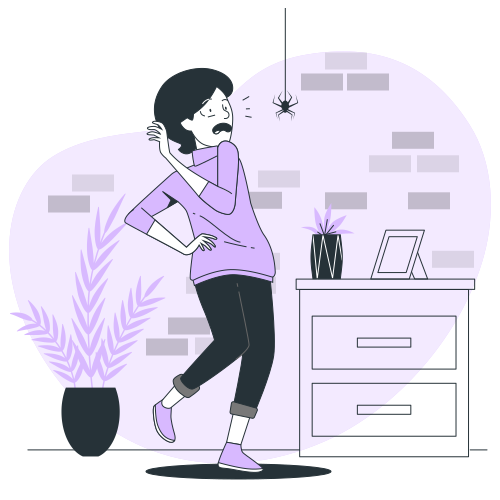
Avoidance feels helpful. And in the short term, it usually is. If you’re afraid of flying, not getting on the plane immediately reduces anxiety. If you’re afraid of needles, cancelling the appointment feels like relief. If you’re afraid of spiders, leaving the room makes your body feel safe again. The difficulty is that relief teaches the brain something important.
Avoiding worked.
Because of that, the next situation often feels just as threatening, or even more so. Without realising it, life gradually becomes organised around avoiding discomfort rather than pursuing what matters. Therapy helps interrupt this cycle. Not by asking you to force yourself into frightening situations, but by helping your brain learn, through carefully planned experience, that it no longer needs to respond as though danger is present.
The goal isn’t to become fearless. It’s to become free.
My approach
I use Cognitive Behavioural Therapy (CBT), including gradual exposure techniques where appropriate, one of the most effective psychological approaches for treating specific phobias. Therapy is always adapted to your pace. Exposure is never about overwhelming you or asking you to face your greatest fear before you’re ready. Instead, we work collaboratively to build confidence through manageable, meaningful steps that allow lasting learning to take place.
The goal isn’t simply to help you face one situation.
It’s to help you regain the freedom that avoidance has gradually taken away.
Online sessions
Online phobia therapy across the UK
Although I am based in Manchester, I provide online therapy for adults throughout the UK. Many specific phobias can be treated effectively through online therapy, allowing us to work together from the comfort of your own home while using evidence-based CBT techniques tailored to your needs.
Before we begin
Your questions,
answered.
You don’t need to have everything figured out before getting in touch.
Can therapy really help if I’ve had this phobia for years?
Yes. Many people live with phobias for years or even decades before seeking therapy. The length of time you’ve experienced the fear doesn’t determine whether change is possible. What matters is helping your brain develop new learning through experiences that gradually replace avoidance with confidence.
Will I have to face my biggest fear straight away?
No. Therapy is collaborative, not something that is done to you. Together we agree on each step, working at a pace that feels manageable while still allowing meaningful progress.
What if I panic during therapy?
Feeling anxious is a normal part of working with a phobia. Therapy isn’t about avoiding anxiety completely. It’s about learning that anxiety, although uncomfortable, can rise and fall without needing to control your decisions. Over time, this allows confidence to grow naturally.
How many therapy sessions will I need?
That is entirely up to you. Therapy isn’t something you commit to for a fixed period, and you are always in control of how long you choose to continue. Some people come to therapy to work through one specific difficulty or life event, while others prefer to take more time to explore longer-standing patterns and make gradual changes.
During our first sessions, we’ll discuss your goals and regularly review how therapy is progressing, so you can decide what feels most helpful for you.
Take the first step
A little space
for something to change.
Living with a phobia often means making decisions based on what feels safest today, even when those decisions quietly limit tomorrow. Therapy offers an opportunity to begin changing that pattern. Not by eliminating fear completely, but by helping you respond to it differently so that it no longer determines where you go, what you do or the life you are able to live.
Book a free consultation to talk about what’s happening and whether working together feels right for you.
Based in Manchester · Online across the UK
Therapy in English & Italian
There can be more to the picture