Online Anxiety therapyWhen anxiety starts making your life smaller
Online CBT with Lisa Marini, based in Manchester and working with adults across the UK. Understand the patterns keeping anxiety going and begin living more freely.
Sessions in English & Italian
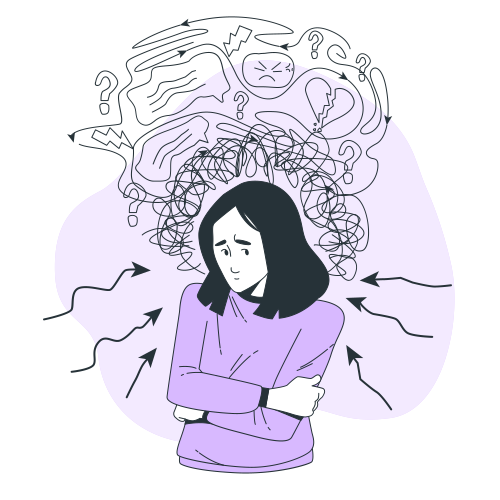
Anxiety rarely arrives as one dramatic event. More often, it quietly begins reshaping your life. Perhaps you started checking things a little more carefully. Declining invitations because they felt too overwhelming. Searching online for reassurance after noticing a physical symptom. Preparing for conversations long before they happened. Replaying mistakes that everyone else had already forgotten.
Over time, these small adjustments can become the way you live. Many people come to therapy believing that anxiety is the problem they need to get rid of. In reality, anxiety is often only one part of the picture. The real difficulty is how much space it has gradually taken away from the life you want to live.
If your world has become increasingly organised around avoiding uncertainty, preventing mistakes or feeling "safe enough" before taking action, therapy can help you understand why this happens and how to begin reversing those patterns.
Understanding it
Anxiety doesn’t always look like panic
Many people imagine anxiety as panic attacks or obvious nervousness. Often it is much quieter than that. It can look like someone who appears calm while constantly analysing every conversation after it ends. It can look like saying yes to everything because disappointing people feels unbearable. It can look like endlessly researching before making a decision, convincing yourself that you simply need "a bit more information." It can even look like being highly organised, highly responsible and highly successful, while privately feeling exhausted from the effort it takes to keep everything under control.
Because these behaviours often seem sensible, people can live with anxiety for years before recognising how much it is influencing their daily lives.
What keeps it going
The cycle that keeps anxiety alive
One of the most frustrating aspects of anxiety is that many of the things we naturally do to feel better can unintentionally strengthen it. Avoiding a difficult situation may bring immediate relief. Seeking reassurance may calm your mind for a few hours. Checking your body may temporarily convince you that everything is fine.
Preparing for every possible outcome may help you feel more in control. None of these responses are irrational. They make perfect sense when your brain is trying to protect you. The difficulty is that each time anxiety disappears because of these strategies, your brain learns that the danger must have been real. Instead of building confidence in your ability to cope, it becomes increasingly dependent on the behaviours that reduced the anxiety in the first place.
Therapy is not about removing anxiety overnight. It is about helping your brain discover something it has had very little opportunity to learn:
Perhaps I can cope, even without all these safety behaviours.
That shift often becomes the beginning of lasting change.
What I help with
The types of anxiety I commonly work with
People experience anxiety in many different ways. Therapy is always tailored to your individual experiences rather than fitting you into a diagnostic label.
I commonly support people experiencing:
- Generalised anxiety and excessive worry
- Panic attacks and panic disorder
- Health anxiety
- Social anxiety
- Specific phobias
- Work-related anxiety
- Fear of uncertainty
- Anxiety linked to major life changes
- Persistent overthinking

How therapy helps
How therapy can help
Good therapy is not about teaching positive thinking or encouraging you to ignore difficult emotions. Instead, we work together to understand the particular patterns that keep your anxiety going. We explore how your thoughts, emotions, physical sensations and behaviours interact, identifying the habits that may have become invisible simply because you’ve been relying on them for so long.
Together we gradually test new ways of responding to anxiety, allowing confidence to develop through experience rather than reassurance. The aim is not to become fearless.
The aim is to reach a point where anxiety no longer gets the final say in your decisions.
My approach
I use Cognitive Behavioural Therapy (CBT), one of the most extensively researched psychological therapies for anxiety. Although CBT provides the framework, therapy is never delivered as a rigid set of techniques. Every person’s anxiety has developed through a unique combination of experiences, beliefs and coping strategies, so therapy should reflect that complexity.
My role is not to tell you what to do. It is to help you understand your own mind well enough that the patterns keeping anxiety alive begin to make sense, and therefore become possible to change.
Online sessions
Online anxiety therapy across the UK
Although I am based in Manchester, I work online with adults across the UK. For many people, online therapy removes practical barriers that might otherwise delay seeking support. It allows therapy to fit around work, family life and other commitments while providing the same structured, collaborative approach as face-to-face sessions.
Before we begin
Your questions,
answered.
You don’t need to have everything figured out before getting in touch.
Will therapy stop me feeling anxious?
Probably not, and that isn’t the goal. Anxiety is an important human emotion. Therapy aims to change your relationship with anxiety so that it becomes information rather than something that dictates your choices.
I’ve always been an anxious person. Can therapy still help?
Many people describe anxiety as part of their personality because they have lived with it for so long. Often, therapy reveals that what feels like personality is actually a collection of understandable habits, beliefs and coping strategies that have become deeply established over time.
Do I need a diagnosis before starting therapy?
No. Many people seek therapy because they know something isn’t working, even if they don’t have a specific diagnosis. We begin with understanding your experiences rather than fitting them into a label.
Is online therapy effective?
Research suggests that online psychological therapy can be as effective as face-to-face therapy for many anxiety difficulties. What matters most is having a structured therapeutic approach and a collaborative working relationship.
Take the first step
A little space
for something to change.
Living with anxiety often means waiting for the "right time" before making changes. Ironically, anxiety is very good at convincing us that we should wait until we feel more certain, more confident or more prepared. Therapy offers an opportunity to begin before that feeling arrives.
Book a free consultation to talk about what’s happening and whether working together feels right for you.
Based in Manchester · Online across the UK
Therapy in English & Italian
There can be more to the picture