Online Therapy for expatsWhen the hardest part isn’t moving. It’s becoming someone new.
Online therapy for expats and international professionals living in the UK. Evidence-based CBT with Lisa Marini, informed by her own experience of building a life abroad.
Sessions in English & Italian

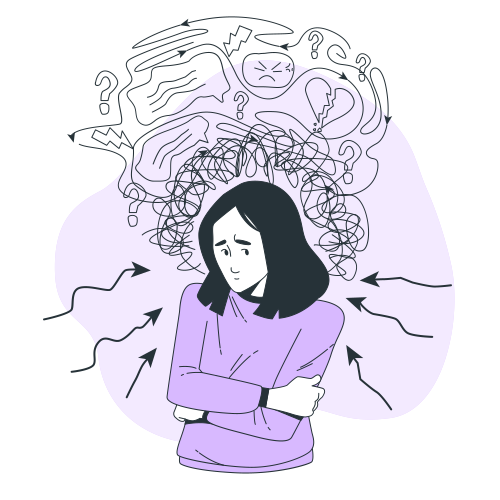
Moving abroad changes much more than your address. It changes the language you think in. The relationships you rely on. The routines that once felt effortless. The way you explain yourself. Even the version of yourself that other people get to know. At first, these changes can feel exciting. Over time, however, they can become quietly exhausting.
Many people tell me they feel caught between two worlds. They no longer feel entirely at home in their country of origin, yet they don’t fully belong in the new one either. You may have built a successful career, learnt to navigate a different healthcare system, adapted to unfamiliar social norms and created a life that looks settled from the outside.
Yet internally, something feels different. You miss people who have continued living their lives without you. You notice yourself feeling like a different version of yourself depending on which language you’re speaking. You wonder why something that was supposed to be exciting sometimes feels surprisingly lonely. These experiences are far more common than many people realise.
Living abroad doesn’t only change where you live. It often changes how you experience yourself.
Understanding it
Living abroad isn’t just a practical adjustment
People often expect the biggest challenges to involve paperwork, finding somewhere to live or adapting to a new language. Those challenges are real. The psychological ones are often less visible. You may find yourself questioning where "home" actually is. You may feel guilty for missing your family while also knowing you chose this life.
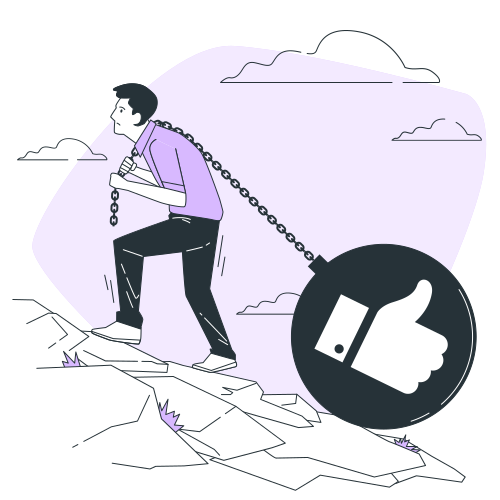
You may hesitate to tell people you’re struggling because you worry they’ll think moving abroad was a mistake. Some people gradually lose confidence because everything requires more mental effort than it once did. Others become emotionally exhausted by constantly adapting to different expectations, social rules or cultural norms. These experiences don’t necessarily mean anything has gone wrong.
They often reflect the emotional cost of adapting to a completely different environment.
Life after the move
The transition often continues long after the move
Many people imagine that once they’ve settled into a new country, the adjustment is complete. In reality, adaptation is rarely a single event. Relationships change. Careers evolve. Family members grow older back home. Friends move on. Life milestones happen in different countries. Questions that once seemed straightforward become more complicated.
Where do I belong?
Where is home now?
Should I stay or should I go back?
Have I become someone different?
These questions don’t necessarily appear during the first year abroad. For many people, they emerge much later, once the practical challenges have faded and the deeper psychological ones become easier to notice.
My approach
I use Cognitive Behavioural Therapy (CBT), one of the most extensively researched psychological therapies for a wide range of emotional difficulties. Alongside my professional training, I also bring lived experience of relocating to another country and building a life away from home. This means I understand many of the practical, emotional and cultural challenges that relocation can bring, not only from a psychological perspective but through personal experience as well.
While every person’s story is different, clients often tell me they appreciate working with someone who already understands many of the unspoken aspects of living abroad, rather than needing to explain them from the beginning. Therapy remains tailored to your individual experiences, combining evidence-based practice with a culturally informed understanding of migration, adaptation and identity.
What I help with
The difficulties I commonly support people with
Living abroad can affect many different areas of emotional wellbeing.
I commonly support people experiencing:
- Adjustment difficulties after relocating
- Homesickness
- Loneliness and isolation
- Identity and belonging
- Relationship challenges
- Work-related stress
- Career transitions
- Anxiety and overthinking
- Low mood
- Self-doubt and loss of confidence
- Major life transitions
- The emotional impact of living between cultures
How therapy helps
How therapy can help
Therapy isn’t about deciding whether moving abroad was the right decision. It’s about understanding how the experience has shaped you and helping you build a life that feels genuinely yours. Together we explore the emotional impact of relocation, the expectations you’ve placed on yourself and the patterns that may now be contributing to anxiety, stress, low mood or self-doubt.
Many people arrive believing there is something wrong with them because they haven’t "settled" in the way they expected. Often, therapy reveals that they have been adapting continuously for years without fully recognising the psychological effort this requires. Once these patterns become clearer, we focus on what can be changed in the present.
The goal isn’t simply to survive living abroad.
It’s to feel at home in your own life again, wherever that life happens to be.
Online sessions
Online therapy for expats and international professionals across the UK
Although I am based in Manchester, I provide online therapy for adults throughout the UK. Whether you’ve recently relocated, have lived abroad for many years or are still finding your feet in the UK, online therapy offers flexible access to professional support wherever you are in the UK.
Before we begin
Your questions,
answered.
You don’t need to have everything figured out before getting in touch.
I moved abroad years ago. Can relocation still affect my mental health?
Yes. The emotional impact of relocation doesn’t always appear immediately. Many people cope well with the practical challenges of moving, only to notice feelings of loneliness, uncertainty or loss years later as careers, relationships and life circumstances evolve. Therapy can help make sense of those experiences, regardless of how long ago you moved.
Will you understand what it’s like to live abroad?
Alongside my professional training, I also have lived experience of relocating to another country. While every person’s journey is unique, this allows me to understand many of the emotional, cultural and practical adjustments that people living abroad often face, without assuming that everyone’s experience is the same.
Do I need to be struggling with anxiety or depression to benefit from therapy?
Not at all. Many people seek therapy because they feel disconnected, unsettled or uncertain about where they belong, rather than because they have a specific mental health diagnosis. Therapy can help you understand these experiences and prevent them from gradually affecting other areas of your wellbeing.
How many therapy sessions will I need?
That is entirely up to you. Therapy isn’t something you commit to for a fixed period, and you are always in control of how long you choose to continue. Some people come to therapy to work through one specific difficulty or life event, while others prefer to take more time to explore longer-standing patterns and make gradual changes.
During our first sessions, we’ll discuss your goals and regularly review how therapy is progressing, so you can decide what feels most helpful for you.
Take the first step
A little space
for something to change.
Living abroad asks a great deal of us. It invites us to build new routines, relationships and identities while quietly letting go of parts of the life we once knew. That process can be enriching, but it can also be emotionally demanding. Therapy offers a space to understand that experience, reconnect with yourself and build a life that feels meaningful, wherever you choose to call home.
Book a free consultation to talk about what’s happening and whether working together feels right for you.
Based in Manchester · Online across the UK
Therapy in English & Italian
There can be more to the picture