Online OCD therapyWhen your mind demands certainty that life simply can’t provide
Online CBT, including Exposure and Response Prevention, with Lisa Marini. Support for adults across the UK to change the cycles of doubt, compulsions and reassurance.
Sessions in English & Italian

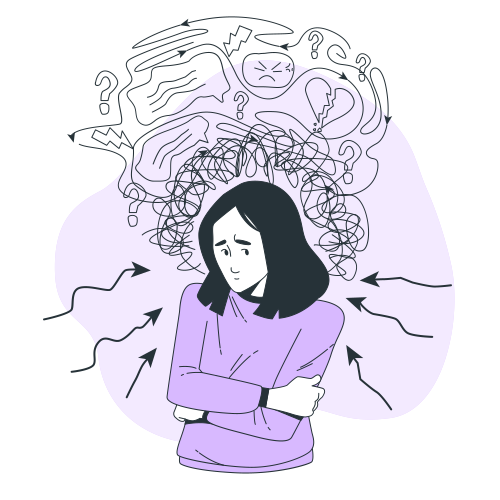
Everyone has unwanted thoughts. Most people notice them and move on. For someone experiencing Obsessive-Compulsive Disorder (OCD), the thought doesn’t simply pass. It lingers. It demands attention. It raises a question that suddenly feels too important to ignore.
What if I really meant that?
What if I’ve contaminated someone?
What if I made a mistake without noticing?
What if I’m responsible for something terrible happening?
The thought itself is rarely the problem. It’s the overwhelming need to know, with absolute certainty, that the feared outcome isn’t true. That search for certainty can gradually become exhausting, consuming hours of your day and leaving very little room for anything else.
Understanding it
OCD isn’t about the thoughts
One of the biggest misconceptions about OCD is that it is defined by the content of intrusive thoughts. In reality, people with and without OCD can experience intrusive thoughts about contamination, harm, relationships, religion, sexuality, morality, health and countless other topics. The theme often changes. The underlying process usually doesn’t. What matters is how you approach your thoughts and whether you let them determine your life, or not.
OCD persuades you that certainty is possible if you just think a little longer, check one more time or seek reassurance in exactly the right way. Unfortunately, certainty never lasts. For a brief moment, you feel relieved. Then another doubt appears. The cycle begins again. Many people tell me they know their fears seem irrational, yet they still feel completely real.
That is one of the reasons OCD can feel so confusing and distressing.
What keeps it going
The cycle that keeps OCD going
OCD is incredibly convincing because the things you do to reduce anxiety usually work… At least for a little while. You check. You wash. You repeat something mentally. You avoid. You search online. You ask someone for reassurance. Anxiety falls. The problem is that your brain doesn’t learn that the situation was actually safe.
Instead, it learns something different.
I’m only safe because I carried out the compulsion.
Each repetition strengthens the cycle. Not because you’re weak. Not because you’re irrational. But because your brain is trying to protect you in the only way it currently knows how. Therapy helps break this cycle by gradually reducing the need for certainty rather than trying to eliminate every intrusive thought. The goal isn’t to stop having unwanted thoughts.
It’s to stop living as though every unwanted thought requires an answer.
What I help with
The types of OCD I commonly work with
OCD can affect many different areas of life and often changes over time.
I commonly support people experiencing:
- Contamination OCD
- Checking OCD
- Responsibility OCD
- Harm OCD
- Relationship OCD (ROCD)
- Health-related obsessions
- Religious or moral OCD
- Sexual intrusive thoughts
- Mental compulsions and rumination
- Reassurance seeking
- Fear of uncertainty
How therapy helps
How therapy can help
One of the biggest myths about OCD is that therapy teaches you to convince yourself your fears are impossible. That isn’t the aim. Trying to prove that something can never happen often becomes another form of reassurance, and reassurance is exactly what OCD is searching for. Instead, therapy helps you develop a different relationship with uncertainty.
Together we identify the patterns that have been maintaining OCD and gradually reduce the compulsions, checking and reassurance that have kept the cycle alive. As this happens, many people notice something surprising. The intrusive thoughts often become less powerful, not because they’ve been disproved, but because they no longer require a response.
Freedom comes from changing how you respond to uncertainty, rather than trying to eliminate uncertainty altogether.
My approach
I use Cognitive Behavioural Therapy (CBT), including Exposure and Response Prevention (ERP), which is considered the psychological treatment of choice for OCD. Therapy is collaborative, structured and always tailored to your individual experiences. Exposure work is never about forcing you into situations before you’re ready or making you face your biggest fears immediately.
Instead, we develop a shared understanding of how OCD operates in your life before gradually helping you respond differently to the situations that have been maintaining the cycle. The aim isn’t to prove that nothing bad could ever happen.
It’s to help you regain the freedom to live your life without OCD constantly demanding certainty.
Online sessions
Online OCD therapy across the UK
Although I am based in Manchester, I provide online therapy for adults throughout the UK. Research shows that CBT and ERP can be delivered effectively online, allowing you to access evidence-based treatment wherever you are in the UK.
Before we begin
Your questions,
answered.
You don’t need to have everything figured out before getting in touch.
What if my intrusive thoughts feel too disturbing to talk about?
This is one of the most common concerns people have before starting therapy. OCD can involve thoughts that feel shocking, frightening or completely out of character. Many people worry that saying them out loud means something about who they are. In reality, therapists who work with OCD hear these themes regularly. You won’t be judged, and you won’t have to convince me that you’re a good person before we begin.
Will therapy get rid of my intrusive thoughts?
Probably not completely, because intrusive thoughts are a normal part of being human. The difference is that most people are able to let them pass without attaching meaning to them. The goal of therapy isn’t to eliminate every unwanted thought. It’s to help you respond differently so that the thoughts lose their ability to dominate your attention and behaviour.
Why can’t I just ignore the thoughts?
Most people with OCD have already tried. The difficulty is that deliberately trying not to think about something often makes it even more noticeable. Therapy doesn’t teach you to suppress intrusive thoughts. Instead, it helps you change the way you respond to them, so they gradually become less significant.
How many therapy sessions will I need?
That is entirely up to you. Therapy isn’t something you commit to for a fixed period, and you are always in control of how long you choose to continue. Some people come to therapy to work through one specific difficulty or life event, while others prefer to take more time to explore longer-standing patterns and make gradual changes.
During our first sessions, we’ll discuss your goals and regularly review how therapy is progressing, so you can decide what feels most helpful for you.
Take the first step
A little space
for something to change.
Living with OCD can feel like being trapped in an endless conversation with your own mind. Every answer seems to create another question. Every moment of certainty quickly disappears. Therapy offers an opportunity to step out of that cycle. Not by finding perfect certainty, but by discovering that you can live a full and meaningful life without needing certainty in the first place.
Book a free consultation to talk about what’s happening and whether working together feels right for you.
Based in Manchester · Online across the UK
Therapy in English & Italian
There can be more to the picture